When the Calendar Lies: How Creatives Are Finding Beauty in Broken Seasons
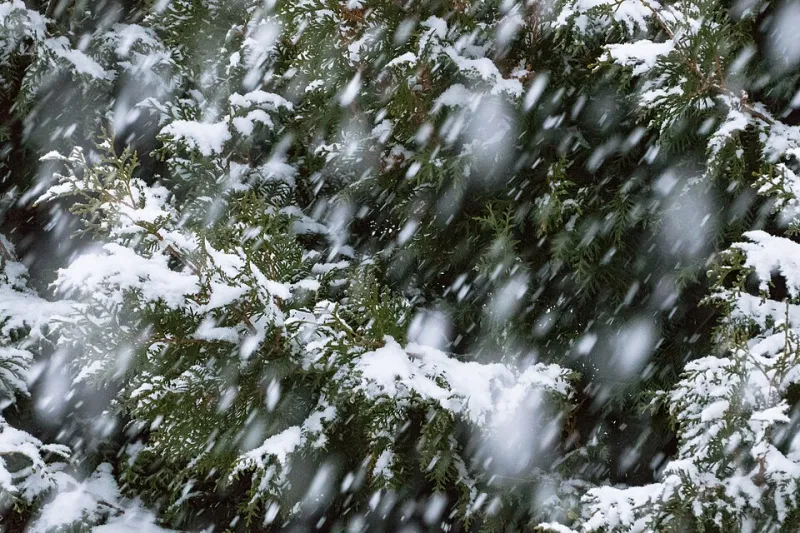
Photo: W.carter, CC0, via Wikimedia Commons
There's a particular kind of visual vertigo that hits when the world outside your window doesn't match the month on your phone. You're bundled up in a scarf, coffee in hand, fully committed to December — and then you step outside into air that smells like May. The light is wrong. The temperature is wrong. And somewhere in your visual brain, a circuit quietly trips.
Photographers know this feeling intimately. And increasingly, they're not looking away from it.
The Eye Expects a Script
Human vision isn't just a passive recorder. It's a prediction machine. We walk into late November already primed for a certain palette — bare branches, low golden light, that particular gray-blue that settles over the Midwest like a wool blanket. When nature delivers something else entirely — say, a 72-degree afternoon in Nashville on December 18th, with people in shorts eating ice cream outside — our visual system stutters.
Psychologists call this a schema violation. Designers and photographers tend to call it something less clinical: wrong. The image in front of you doesn't match the internal template. And that gap between expectation and reality? That's where things get genuinely interesting.
The concept of the uncanny has been around since Freud — that creeping unease produced by something familiar that's been subtly distorted. We usually talk about it in the context of robotics or horror film aesthetics. But there's a quieter, more ambient version of it happening every time a season breaks its own rules. A snowstorm rolling through Georgia in March. Cherry blossoms in Chicago getting buried under a late frost. The visual world sending you mixed signals you can't quite decode.
Shooting the Contradiction
For a growing number of photographers, these moments of seasonal confusion have become a subject worth chasing rather than waiting out.
Shoot a kid in a Halloween costume against a backdrop of green leaves — still fully on the trees in a warm October — and you get something that feels vaguely surreal without any digital manipulation. The costume signals one thing. The foliage signals another. The viewer's brain does a small, involuntary double-take, and that tension is where the photograph lives.
Or consider the opposite: late-season snow blanketing daffodils that pushed up too early in a warming spring. That image carries an almost narrative weight. It's not just pretty — it's a story about timing, about systems going slightly haywire, about the gap between biological expectation and atmospheric reality. Photographers in the Pacific Northwest and the upper Midwest have been capturing versions of this for years, but what's changed recently is the intention behind the lens. These aren't accidental shots anymore. Creatives are actively watching the forecast for the weird days.
The Design Language of the Off-Script Moment
Beyond photography, this seasonal uncanny is starting to bleed into broader design conversations. Digital artists and illustrators are experimenting with deliberate palette collisions — pulling warm amber tones typically associated with fall into stark winter compositions, or layering summer saturation over imagery that's clearly cold and bare.
The effect is disorienting in a way that feels oddly honest. Because the truth is, if you live anywhere in the continental US right now, your lived seasonal experience is increasingly non-linear. Winters that feel like October. Springs that skip straight to summer heat. Falls that arrive two weeks late and leave three weeks early. The tidy, predictable four-act structure of the seasonal year is becoming harder to take for granted.
Some designers are leaning into this by building what you might call anomaly palettes — color systems that deliberately resist seasonal convention. Instead of the expected burnt sienna and harvest gold for an autumn-adjacent project, they're pulling in unexpected cool greens or flat, washed-out blues that feel more like a foggy February morning. The result doesn't read as autumn exactly, but it doesn't read as any other season cleanly either. It reads as now. As this specific, slightly-off moment we're all living in.
Why It Feels Unsettling — And Why That Matters
Let's be honest about something: the seasonal uncanny isn't just an aesthetic novelty. It carries real psychological weight. A lot of us anchor our emotional calendars to seasonal cues — the first genuinely cold morning that signals a mental shift into winter mode, the specific smell of spring rain that unlocks something in the limbic system. When those cues arrive at the wrong time, or don't arrive at all, there's a subtle emotional disorientation that goes beyond just noticing the temperature is off.
Creatives are uniquely positioned to sit with that feeling rather than dismiss it. A photographer who frames a sun-drenched Christmas afternoon in Phoenix with the same quiet, observational care usually reserved for a snowy New England scene isn't just documenting weather — they're acknowledging a psychological reality. The image says: this is strange, and we're all living in it together.
There's something almost archival about this impulse. Future audiences looking back at creative work made in this era will see the visual record of a world in seasonal flux — not catastrophically, not apocalyptically, but in that low-grade, persistent way that slowly rewrites what we consider normal.
Finding Your Own Broken Moments
If you're a photographer or designer looking to explore this territory, the entry point is simpler than you might think: just pay attention when something feels visually wrong.
That 60-degree February afternoon when everyone's out in the park looking faintly guilty about enjoying it? Shoot it. The October afternoon when the light looks like August and you can't quite figure out why? That's your frame. The snow on the forsythia, the green Christmas, the summer thunderstorm that rolls through on the first day of fall — these are the moments where the calendar and the world are having an argument, and you get to be the one who documents it.
The seasonal uncanny isn't a flaw in the world's visual programming. It's an invitation. A reminder that the most interesting images often live in the space between what we expected to see and what's actually in front of us.
And right now, that space is wider than it's ever been.