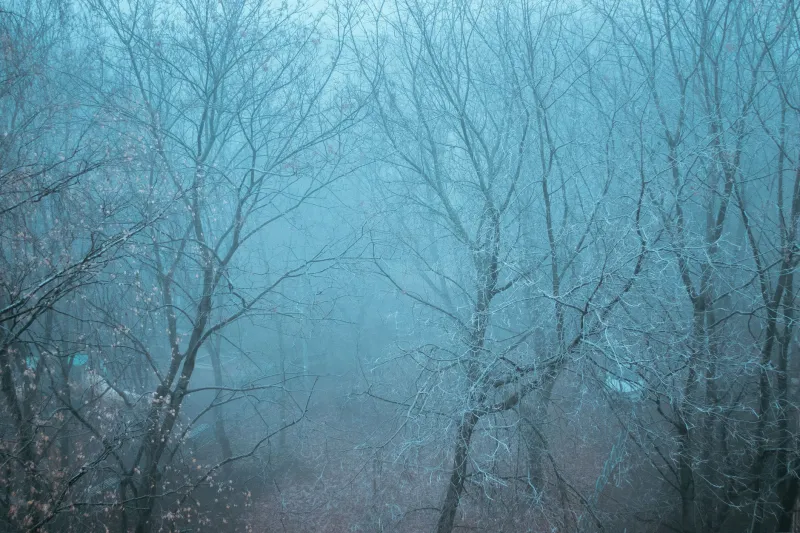
Too Perfect to Feel Real: Why AI Autumn Keeps Missing the Point
Scroll through any design community feed right now and you'll find no shortage of AI-generated autumn scenes. Amber forests. Mist-draped hillsides. Leaves suspended mid-fall against a sky that's been tuned to an almost painful shade of blue. They're gorgeous, technically speaking. And yet — something's off. You can't always name it immediately, but it sits there, this faint wrongness, like a smell that doesn't match the room.
This isn't just nostalgic resistance to new tools. Something genuinely strange is happening in the space between computational image generation and the visual experience of an actual October afternoon in, say, the Catskills or rural Vermont. And for designers and photographers who work hard to capture seasonal authenticity, understanding what AI keeps getting wrong might be more useful than any prompt engineering guide.
The Uncanny Valley Has Leaves Now
The uncanny valley is a concept most people know from robotics and CGI characters — that unsettling dip in comfort that happens when something looks almost-but-not-quite human. It turns out the same phenomenon applies to seasonal imagery. When AI renders autumn, it often produces something that checks every obvious box: warm color temperature, golden-hour lighting, textured foliage, atmospheric haze. But the result frequently lands in a visual no-man's-land where the brain registers beauty and wrongness simultaneously.
Part of this is about what AI is actually doing. These models are trained on massive datasets of images — including an enormous volume of curated, heavily edited, "peak aesthetic" photography. They've essentially learned what autumn looks like on Instagram rather than what autumn looks like at 7:15 a.m. on a Tuesday when you're scraping frost off your windshield in Ohio. The output is autumn distilled into its own highlight reel, and that distillation strips out everything that makes the season feel inhabited.
What the Algorithm Keeps Getting Wrong
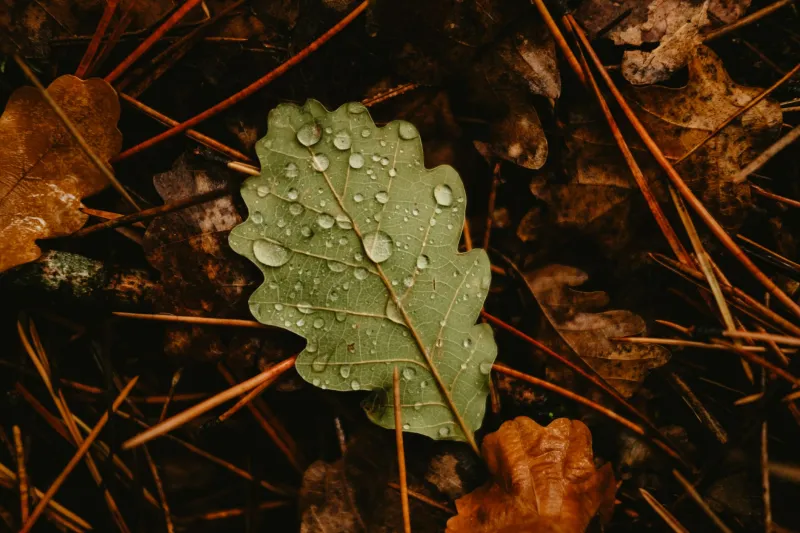
Micro-texture is the first casualty. Real autumn leaves are not uniformly beautiful. They're spotted, split along veins, curled unevenly at the edges, marked by insect damage and weeks of slow desiccation. AI foliage tends toward a kind of idealized leaf-ness — the platonic form of a maple leaf rather than the specific, slightly-battered thing you'd actually kick through in a parking lot. Even when generators add "imperfections," those imperfections have a pattern to them. They're evenly distributed, symmetrically irregular, which is its own kind of tell.
Light diffusion is the second. Autumn light in the real world does something complicated. It scatters differently through thinner, drier air. It bounces off surfaces that are simultaneously wet with morning dew and warm from afternoon sun. The shadows are longer and cooler than summer shadows, but the highlights can still carry residual warmth. AI images tend to flatten this into a single coherent lighting mood — everything bathed in the same quality of light, as if the scene exists inside a perfectly controlled studio. Real fall light is internally contradictory in ways that feel intuitively right to anyone who's spent time outside during the season.
Color transitions are where things get really interesting. A single autumn tree in peak color isn't one shade of red or orange — it's dozens of micro-transitions happening leaf by leaf, sometimes within a single leaf. The shift from green to yellow to orange to red follows biological processes that don't care about aesthetic coherence. AI tends to produce color distributions that are harmonious in a design-school sense: triadic, complementary, well-balanced. Real autumn color is messier. A tree might be 60% still-green at the top, transitioning through chartreuse into a narrow band of brilliant orange before dropping into rust at the branch tips. That biological randomness is what makes it feel alive.
The Weight Problem
There's another quality that's harder to articulate but just as important: weight. Real seasonal environments have a physical presence that photography, at its best, can suggest. The density of cold air. The specific way wet leaves compress underfoot rather than scatter. The way a gray November sky doesn't just look heavy — it feels heavy, pressing the landscape down.
AI imagery is almost always weightless. Everything exists on the same visual plane, lit with the same gentle confidence. There's no sense that anything costs anything — no mud, no chill, no friction. The scenes feel curated rather than found, which is exactly the problem. The best seasonal photography, whether it's an editorial shoot in the Blue Ridge Mountains or a personal project documenting a backyard in Minnesota, carries evidence of the photographer's physical presence in a specific place at a specific time. AI images have no such evidence because there was no presence, no place, no time.
What This Means for Creatives Who Care About Authenticity
None of this is an argument against using AI tools — plenty of designers are finding genuinely interesting ways to integrate generated imagery into their workflows. But it's worth being clear-eyed about what the technology currently can't do, especially if your creative identity is built around seasonal specificity.
If you're a photographer or designer whose work depends on the viewer feeling a season rather than just recognizing it, AI generation is not your competition right now. The gap it leaves — that missing weight, those unharmonious color transitions, that specific micro-texture of a real decaying leaf — is exactly where your work lives.
There's also something worth sitting with here about what these AI failures reveal about human visual perception. We're apparently very good at detecting seasonal inauthenticity even when we can't immediately explain it. The wrongness registers before the analysis does. That suggests our relationship to seasonal imagery is more embodied than we might think — less about recognizing visual patterns and more about matching images against a whole-body memory of what a season actually feels like to move through.
The Realness Gap
Autumn is arguably the most AI-generated season on the internet right now. It's been aestheticized so heavily and for so long that there's a vast training dataset of idealized fall imagery to draw from. And yet that abundance might be exactly why AI autumn feels the most hollow. The models have learned the costume of the season without learning the season itself.
For designers and visual artists working in this space, that's actually useful information. The more AI saturates feeds with technically perfect autumn imagery, the more genuinely observed, physically grounded seasonal work stands out. The imperfections you might be tempted to edit out — the uneven color, the awkward light, the leaf that's more brown than beautiful — are increasingly the markers of authenticity in a landscape full of algorithmic polish.
The uncanny valley cuts both ways. AI imagery is getting good enough to make us notice, more sharply than before, what real looks like.