Designing by Ear: How Audio Clichés Are Quietly Composing Your Seasonal Palettes
Close your eyes and picture autumn for a second. Not a mood board — just the season itself. What do you hear?
If your brain immediately served up something cinematic — strings swelling, maybe a solo cello, leaves rustling in a way that sounds suspiciously produced — you're not alone. Most designers working with seasonal themes are operating off an internal audio track that was composed by film studios, Spotify playlist curators, and nature documentary editors. And that borrowed soundtrack is doing a lot more to shape your color choices than you probably realize.
This is the synesthesia trap. Not the neurological phenomenon where people genuinely experience sounds as colors, but a softer, more insidious version: the way cultural audio shorthand quietly bleeds into visual decision-making, producing seasonal work that feels emotionally resonant but somehow hollow. Like a stage set. Technically correct, experientially thin.
The Playlist That Builds the Palette
Here's a scenario that's probably familiar. You're working on a fall campaign — maybe a brand refresh, maybe a portfolio series, maybe just personal work you're excited about. You open a lo-fi autumn playlist, or throw on some ambient orchestral stuff, and you start designing. The colors that come out? Warm amber. Deep rust. Muted sage. Soft cream. All beautiful. All completely predictable.
The music isn't incidental to that outcome. It's causal.
Research into multisensory perception has shown pretty consistently that sound primes emotional state, and emotional state drives aesthetic preference. When you're listening to slow, warm, minor-key instrumentation, you reach for slow, warm, low-saturation colors. The playlist is composing your palette before your eyes even open to reference images.
The problem isn't that these palettes are bad. They're often gorgeous. The problem is that they're being generated by a cultural script rather than by actual sensory contact with the season you're trying to represent. You're not painting autumn. You're painting the idea of autumn as filtered through decades of film scores and streaming algorithm optimization.
What Fall Actually Sounds Like in the US
Spend a real October morning outside — not in your car, not with earbuds in — and the actual soundscape of autumn is genuinely strange compared to what we've been trained to expect.
In the Northeast, fall sounds like football games two blocks over. It sounds like leaf blowers, which are loud and mechanical and deeply unglamorous. It sounds like the specific creak of a storm door that only gets used when the weather turns. In the Midwest, it's combines running at night, the distant hum of grain elevators, Canada geese doing their thing overhead. In the Pacific Northwest, it's rain on pavement before the dramatic leaf color even peaks — a wet, grey, almost industrial ambiance that has almost nothing in common with the orchestral warmth we associate with the season visually.
None of these sounds are in the autumn playlists. None of them make it into the mood boards. And none of their visual equivalents — the muddy browns, the flat greys, the harsh artificial lighting of a parking lot at dusk — make it into the design work either.
That's not a coincidence. The audio cliché and the visual cliché are protecting each other.
The Lo-Fi Study Beat Problem
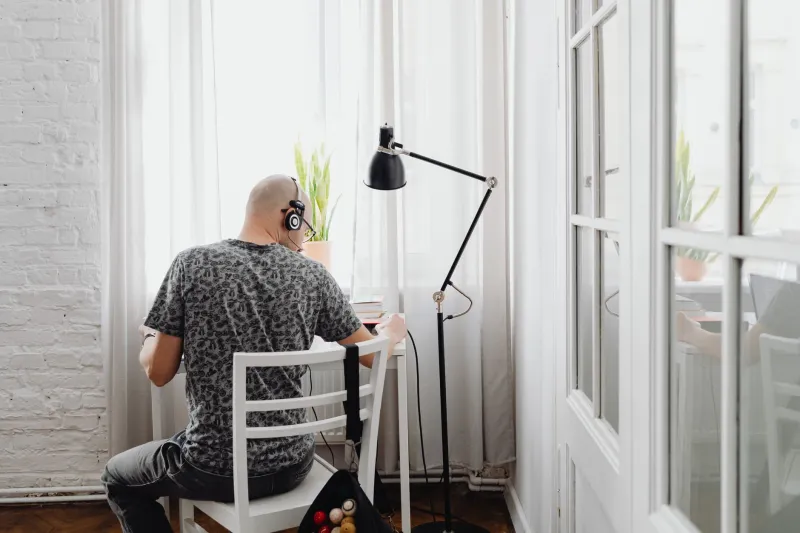
Lo-fi hip-hop deserves its own paragraph here because it's become so dominant as a working soundtrack for designers that its visual language has essentially fused with the act of creative work itself. The aesthetic — warm lamplight, rain on windows, a slightly desaturated vintage palette — is now so associated with the process of designing that it's started to colonize the output.
Designers working in lo-fi mode produce lo-fi-adjacent work. Not always consciously. But the sensory environment you create while working is part of the creative input, and if that environment is always the same curated audio-visual package, your output is going to start converging toward a mean.
This is especially visible in autumn work, where lo-fi's default palette and the cultural palette of fall are already so close to each other. The reinforcement loop is tight. You listen to cozy beats, you produce cozy visuals, the algorithm rewards cozy content, you listen to more cozy beats.
Breaking the Audio Spell
So what's the move? A few things worth trying, none of them precious.
Work in silence first. Before you touch a playlist, spend the early phase of a seasonal project in actual quiet. Let your visual references do the work without an audio layer priming your emotional state. The palette that emerges will often be more specific, more surprising, and more grounded in what you're actually looking at.
Record your own ambient sound. This sounds like a lot, but even a five-minute voice memo from a real outdoor location during the season you're designing for can function as a reference point. You're not using it as background music — you're using it as sensory data. What colors do those sounds suggest to you without the cultural scaffolding of a produced track?
Use sound as a contrast check. After you've built out a palette or a composition, play the actual ambient sounds of the season and notice where the dissonance is. If your autumn design feels completely at odds with the sound of a real October afternoon, that gap is worth investigating. It might be intentional. It might be a blind spot.
Diversify your audio references deliberately. If you're going to work with music or ambient sound while designing, try sourcing it from outside the obvious seasonal canon. Field recordings from the Freesound library, regional podcasts recorded outdoors, documentary audio from the specific geography you're trying to evoke. The stranger the audio input, the less likely it is to be dragging your palette toward the cultural mean.
The Deeper Point About Authenticity
Seasonal design that resonates — really resonates, not just performs well on a mood board — tends to have a specificity to it that you can feel even if you can't name it. There's a reason some autumn photography stops you cold and other autumn photography just looks like autumn photography.
That specificity almost always comes from genuine sensory contact with the subject. Not just visual contact, either. The designers and photographers doing the most interesting seasonal work tend to be people who are actually outside, actually listening, actually letting the full sensory texture of a season inform what they make.
You can't fake that with a playlist. You can approximate it, and sometimes the approximation is good enough. But if you've ever looked at your own seasonal work and felt like something was missing — like it was technically correct but emotionally generic — the audio layer is worth examining.
The season has a real sound. It's messier and more specific and less cinematic than what's in your headphones. Getting closer to that sound, even imperfectly, might be exactly what your visual work has been waiting for.