One-Season Designers: What You Lose When You Only Live in One Part of the Year
Somewhere in the US right now, there's a designer who hasn't thought about green in eight months. Not because they dislike green — they probably don't have strong feelings about it either way. But their entire client roster is Halloween-adjacent, their portfolio is a wall of orange and black and deep burgundy, and the last time they genuinely engaged with the visual language of spring was probably before they landed the account that made their career.
This is seasonal tunnel vision. And it's a lot more common than the design community talks about.
The Commercial Logic That Creates the Trap
Specialization makes financial sense. A designer who owns a specific aesthetic niche — Christmas packaging, Halloween brand identity, summer music festival visuals — can charge more, work faster, and build a referral network that feeds itself. The market rewards depth of expertise. There's nothing wrong with that.
The problem isn't the specialization. The problem is what happens to the parts of your visual perception that stop getting used.
Creative vision is a skill, and like most skills, it atrophies when it isn't exercised. A photographer who shoots exclusively in the flat gray light of overcast November days for three years is going to struggle when a client suddenly needs work that captures the hard, high-contrast brilliance of a July afternoon. Not because they've forgotten what summer looks like — but because they haven't been seeing it. There's a difference between recognizing a season and being genuinely tuned into its visual frequency.
The Halloween illustrator who hasn't engaged with spring in years doesn't just lack spring references. They've lost the specific attentiveness to spring that makes the difference between a technically accurate depiction and a living one.
What Seasonal Variety Actually Trains
Working across all four seasons isn't just about expanding your portfolio range. Each season develops a different set of perceptual muscles.
Winter trains you in restraint and tonal subtlety. The palette is narrow — whites, grays, the occasional deep blue or brown. To make winter work feel rich rather than flat, you have to develop sensitivity to extremely small color variations. The difference between the white of fresh snow and the white of an overcast sky is maybe two or three points on a color picker, but getting it wrong makes a winter composition feel fake in a way that's hard to articulate. Working in winter teaches you to see in small increments.
Spring trains you in complexity and transition. Spring palettes are genuinely difficult because they're not stable — the season is in constant motion, with new greens appearing in stages and the light shifting almost weekly as the sun climbs higher. Designing for spring requires comfort with color relationships that are slightly off-balance, not quite settled. That's a skill that transfers directly to designing for any transitional moment in a brand's identity.
Summer trains you in saturation management. High summer light is unforgiving — colors are pushed toward their maximum intensity, and the challenge is working with that intensity without tipping into visual noise. Summer forces you to develop judgment about when saturation is doing work and when it's just loud.
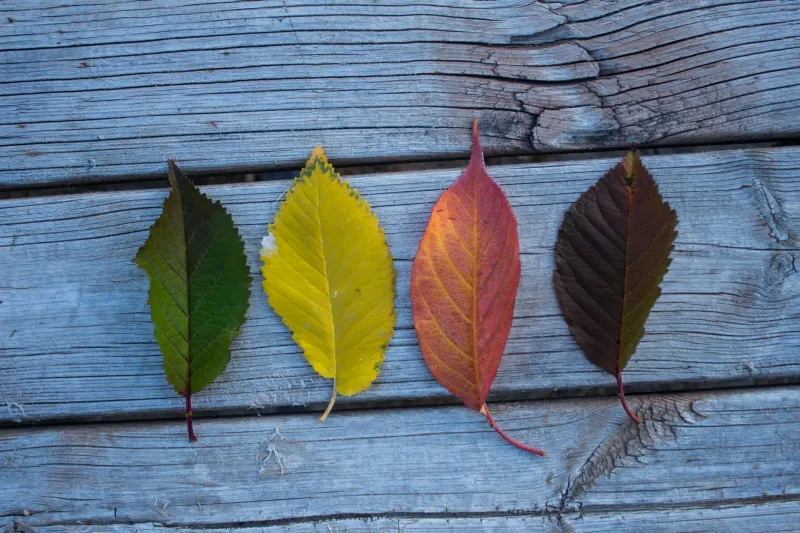
Autumn trains you in harmony and richness. The fall palette is famous for a reason — it's one of the most naturally harmonious color arrangements in the natural world. But working in it too exclusively (and this is the irony that the internet's autumn obsession has created) can make you dependent on colors that already work together, rather than developing the skill to make colors work together.
If you're only ever working in one of these modes, you're only ever developing one of these skills. The others go quiet.
The Psychological Side of Seasonal Lock-In
There's also a mental dimension to this that doesn't get discussed enough. Creatives who work in the same seasonal visual language year-round often describe a kind of flatness that sets in after a while — a sense that their work is competent but not surprising, even to themselves. They attribute it to burnout, or to the client relationship, or to the specific project. Sometimes those explanations are right. But sometimes what they're experiencing is a perceptual narrowing that comes from not having their visual assumptions challenged by a different season's light.
Seasons are, among other things, a built-in reset mechanism. The shift from summer to fall doesn't just change the colors outside — it changes the quality of light, the length of the day, the temperature of shadows, the behavior of humidity in the air. Every one of those changes is a prompt to look differently. Designers who work in the same seasonal aesthetic year-round are opting out of that reset cycle, and their eyes pay a price.
Some of the most interesting creative work happens in the first weeks of a new season, when a designer's eye is freshly calibrated to a different set of conditions. That recalibration is something you can't get from a mood board or a reference folder. It comes from actually paying attention to a different season, in real time, with genuine curiosity.
Making the Case for Deliberate Off-Season Work
The practical argument here isn't that you should abandon your niche or chase clients in markets that don't fit your expertise. It's that you should maintain a deliberate off-season creative practice — work that you do for your own development, outside of commercial commitments.
If you're a Christmas designer, spend some time in April making work about spring. Not to sell it. Not to build a new client base. Just to use the perceptual muscles that your primary work isn't using. Shoot a spring walk. Build a color study from the light in May. Design something that has nothing to do with December.
If you're a summer wedding photographer who packs up in September, consider spending October and November shooting deliberately in the off-season light — not for clients, but for yourself. The quality of late autumn light in the US is genuinely extraordinary, and spending time in it will change what you see when you return to your summer work in April.
The goal isn't a seasonally balanced portfolio. The goal is a seasonally balanced eye. Those are different things, and only one of them is visible in your work.
The Year Is the Full Curriculum
The most visually sophisticated creatives — the ones whose work feels like it comes from a deep, lived understanding of the world rather than a well-curated reference library — tend to be people who have spent real time in all four seasons, paying genuine attention. Not just passing through. Not just pulling stock images. Actually looking at what the light does in January, what the color does in April, what the shadows do in July.
The year is the full curriculum. If you're only taking one class, you're leaving most of the education on the table — and eventually, your work will show it.